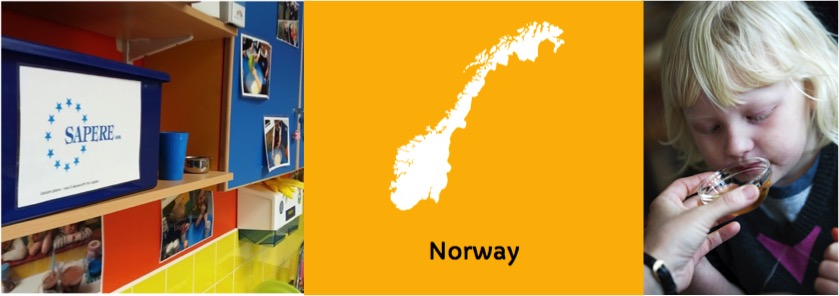
Since 2014, the Research Centre for Lifecourse Nutrition at the University of Agder has conducted research on the Sapere method in Norwegian Early Childhood Education and Care (ECEC) settings. Since 2023, the Centre has been the Norwegian member of Sapere International.
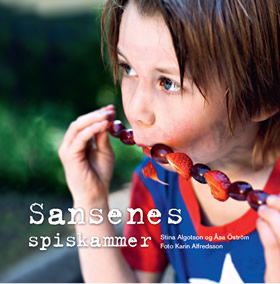
Sensory education is an important research focus within the Centre. Our work is based on the Swedish translation and adaptation of the Sapere method, originally developed from Jacques Puisais’ book Taste and Children. Algotson and Öström’s book for preschool children, Sinnenas Skafferi (Sansenes spiskammer in Norwegian), has formed the basis for the Sapere sessions that we have developed and evaluated.
Reasearch
Through two randomized controlled trials, we have evaluated the effects of the Sapere method on children’s food acceptance and dietary intake. In addition, we have explored how ECEC staff in Norway experience using the Sapere method in their daily practice.
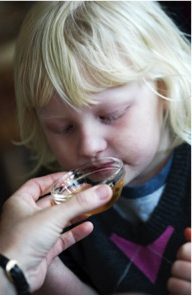
Our qualitative findings suggest that, according to ECEC staff, children aged 1-3 years:
- develop greater awareness and understanding of their senses;
- improve their ability to describe sensory experiences, moving beyond simple statements such as “I like it” or “I don’t like it,” thereby strengthening language and communication skills;
- become more willing to taste unfamiliar foods and develop greater food courage (madmod, a Danish concept describing the confidence and willingness to explore and try new foods);
- gain experience with a wider variety of vegetables and dishes, broadening their food repertoire;
- share sensory experiences with peers and adults; and
- enjoy shared meals with other children, supporting the development of social competence.
ECEC staff report that Sapere sessions are easy to conduct and can be readily integrated into everyday pedagogical practice.
We also found that the method influenced the staff themselves, increasing their willingness to try new foods.
Furthermore, our studies suggest that educators had previously underestimated young children’s curiosity and readiness to explore unfamiliar foods.
In 2021, we initiated the implementation of the Sapere method in ECEC settings across several Norwegian municipalities. This work aims to identify effective strategies for scaling up and implementing the Sapere method nationally.
Research
- Blomkvist, E., Helland, S. H., Hillesund, E. R., & Øverby, N. C. (2018). A cluster randomized web-based intervention trial to reduce food neophobia and promote healthy diets among one-year-old children in kindergarten: study protocol. BMC pediatrics, 18(1)(232). https://doi.org/ https://doi.org/10.1186/s12887-018-1206-8
- Blomkvist, E., Wills, A. K., Helland, S. H., Hillesund, E. R., & Øverby, N. C. (2021). Effectiveness of a kindergarten-based intervention to increase vegetable intake and reduce food neophobia amongst 1-year-old children: a cluster randomised controlled trial. Food & Nutrition Research, 65. https://doi.org/10.29219/fnr.v65.7679
- Helland, S. H., Øverby, N. C., Myrvoll Blomkvist, E. A., Hillesund, E. R., Strömmer, S., Barker, M., & Bjørkkjær, T. (2021). Wow! They really like celeriac! Kindergarten teachers’ experiences of an intervention to increase 1-year-olds’ acceptance of vegetables. Appetite, 166, 105581. https://doi.org/https://doi.org/10.1016/j.appet.2021.105581
- Johannessen, B., Helland, S. H., Bere, E., Øverby, N. C., & Fegran, L. (2018). “A bumpy road”: Kindergarten staff’s experiences with an intervention to promote healthy diets in toddlers. Appetite. https://doi.org/https://doi.org/10.1016/j.appet.2018.04.008
A Brief History of Sensory Education in Norway
Sensory education was introduced and disseminated in Norway through the efforts of Norsk Kulturarv and Nofima, inspired by the ideas of Arne Brimi and Einar Risvik.
Since 2013, these organizations have provided sensory education to thousands of children and offered free training courses for teachers in schools and ECEC settings.
Through this work, they have become important ambassadors for food literacy and the preservation of Norwegian food culture.
Contact:
Tasting the future of food education: 10th Sapere International Symposium
Wednesday, 18 November 9:00-21:30 & Thursday, 19 November 9:00-17:00 Location: Campus of Wageningen University & Research, Orion Building (Bronland 1, 6708 WH, Wageningen, the Netherlands) Fee: €100 excl. VAT (€80 for Sapere members) including lunch & dinner on 18th and lunch, drinks and snacks on 19th What does the future of food education look like? How can…

